
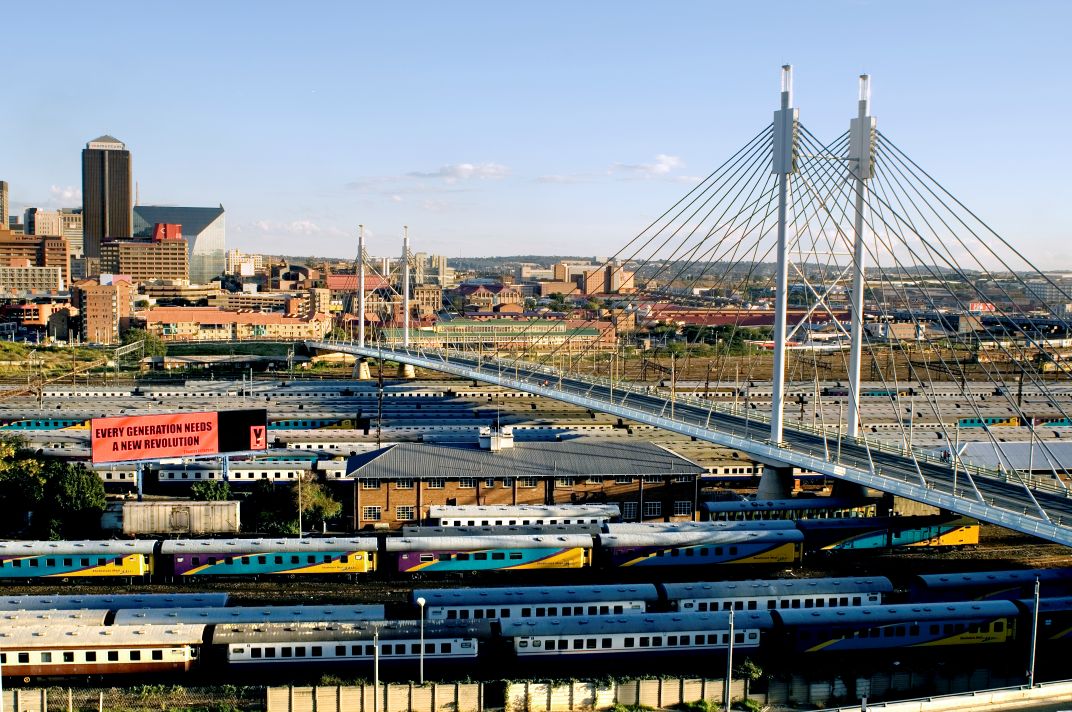
For more than a decade, South Africa’s logistics system has faced mounting pressure as freight steadily shifted from rail to road. The consequences have been felt across the economy: rising transport costs, congested roads, increased infrastructure maintenance requirements and growing supply chain inefficiencies. Recent rail reforms, however, present an opportunity not only to reverse this trend but also to reinforce Gauteng’s position as South Africa’s premier inland logistics hub.
The challenge facing the country’s freight network is well documented. Rail freight volumes have declined significantly over the past decade, with approximately 75-million tonnes of annual freight migrating away from rail. The resulting capacity gap, estimated at around 85- million tonnes per year, has largely been absorbed by road transport, placing enormous pressure on key freight corridors.
This is most evident on the Durban-Gauteng corridor, the backbone of South Africa’s freight economy. More than 58-million tonnes of cargo move along this route annually, with trucks carrying most of that volume. While road transport has filled a critical gap, it has also increased logistics costs and placed additional strain on national infrastructure.
The reality is that logistics competitiveness has become a major determinant of investment attractiveness. Investors increasingly evaluate regions not only on market size, labour availability and infrastructure, but also on the efficiency, reliability and cost of moving goods. In this environment, freight networks are no longer simply transport systems. They are strategic economic assets.
Recent policy reforms have therefore created a significant opportunity. Government’s decision to open sections of the freight rail network to private operators marks one of the most important structural reforms in South Africa’s logistics sector in decades. Eleven private operators have already been granted access across six freight corridors, including multiple operators on the strategic Natcor corridor connecting Durban and Johannesburg.
For Gauteng, the implications are substantial. As the country’s economic heartland and primary inland distribution centre, Gauteng sits at the centre of South Africa’s logistics network. Goods entering through the ports are ultimately distributed through Gauteng to domestic markets and regional destinations across Southern Africa. Any improvement in rail capacity, reliability and efficiency directly enhances the province’s competitiveness.
The potential gains are considerable. Current container volumes between Johannesburg and Durban stand at approximately 2.8-million containers annually, compared to a long-term potential of 11.2-million containers. Unlocking even a portion of this opportunity would stimulate logistics investment, support industrial growth and strengthen Gauteng’s role within regional and continental supply chains.
As a landlocked province anchoring one of the largest economies on the continent, Gauteng’s ability to drive active intra-Africa trade depends heavily on a modernized goods rail network. Ensuring that the rail lines connecting the Eastern Cape and Durban ports to Gauteng remain active and extend outward to the rest of Africa is critical for establishing reliable, high-volume cross-border supply chains. This integrated intermodal capability is a major strategic asset for securing new industrial investments, particularly in the automotive sector.
For instance, the Automotive Industry Development Centre (AIDC) has successfully leveraged these logistics capabilities to facilitate the entry of new Chinese auto manufacturers, into the province’s manufacturing hubs. By guaranteeing that vehicle components and finished products can move efficiently from coastal ports to inland assembly plants and subsequently across the continent, an active rail network cements Gauteng’s status as the indispensable gateway for continental commerce.
The benefits extend beyond freight movement. A more efficient rail system can support manufacturing competitiveness, improve export performance and reduce supply chain costs for businesses operating in Gauteng. These are precisely the types of conditions that influence investment decisions and contribute to long-term economic growth.
This is where the Gauteng Growth and Development Agency (GGDA) has an important role to play. Infrastructure investment alone does not automatically translate into economic outcomes. Strategic coordination, investor facilitation and promotion are equally important. By supporting investment in logistics infrastructure, facilitating engagement with industry stakeholders and positioning Gauteng as the gateway to regional markets, the GGDA helps create the conditions for sustainable economic expansion.
As South Africa reshapes its logistics landscape, Gauteng remains uniquely positioned to leverage these reforms, strengthen its competitive advantage and reinforce its role as the nation’s logistics and investment gateway.

Invest in Gauteng
Gauteng is the epicenter for growth – it is South Africa’s economic engine and an important launching pad for local and international businesses into African markets.
As the implementing arm of the Gauteng Department of Economic Development (GDED), the GGDA provides a seamless one-stop shop service aimed at unlocking investment and expansion opportunities for local and global businesses, whilst facilitating the ease of doing business.
Contact the GGDA now to discuss your investment objectives: