
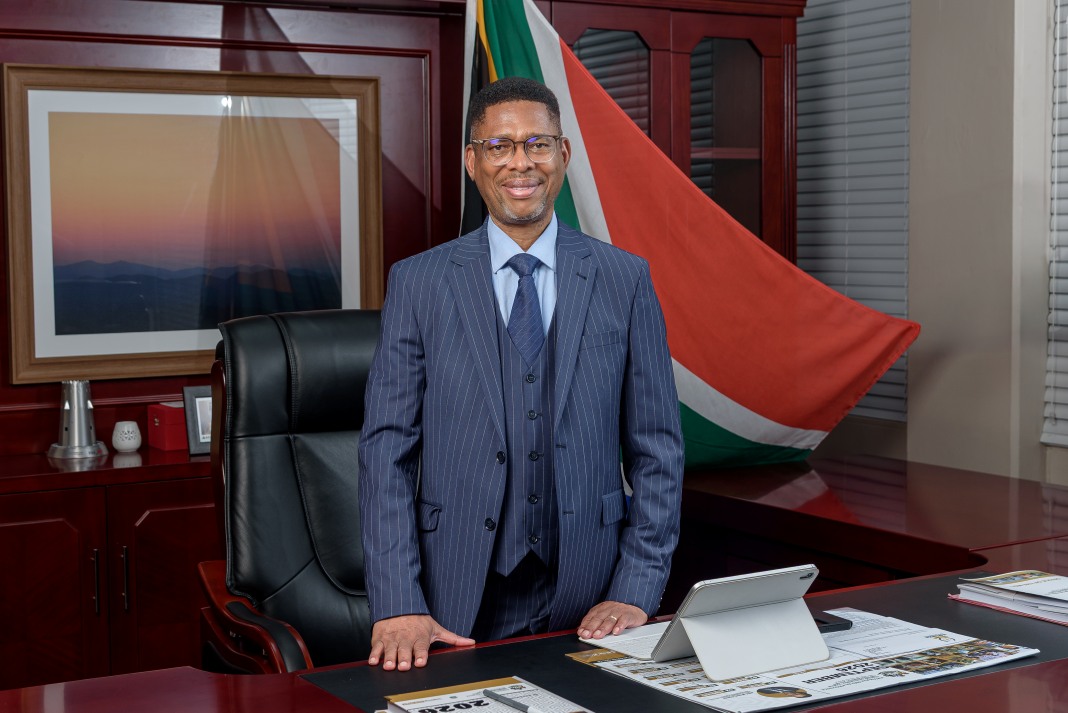
In announcing the 2026/27 budget of R3.77-billion for the KwaZulu-Natal Department of Economic Development, Tourism and Environmental Affairs (EDTEA), Reverend Musa Zondi reflected on recent achievements and set strategic goals for the future. This is an extract from his speech to the KwaZulu-Natal Provincial Legislature on 14 July 2026.
Economic development cannot wait and in our province we are moving forward with urgency and purpose. We present this 2026/27 budget at a time that demands not just vision, but a relentless focus on implementation and measurable results. This budget is a commitment to the 7th Administration’s priority of taking the economy to the people and ensuring that growth, opportunity and development reach every corner of KwaZulu-Natal.
It prioritises catalytic interventions, backs rural and township entrepreneurs, advances industrialisation and positions inclusive growth as the foundation of economic transformation. It is within this context that we present this budget under the theme: “Taking the economy to the people: delivering inclusive growth and opportunities across KwaZulu-Natal.”
This is not a slogan; it is a working agenda.
It represents our commitment to take the economy to the people, ensuring that the wealth of our province is not confined to the metros but is felt in the hands of the informal trader in Mandeni, the youth entrepreneur in Nongoma and the subsistence farmer in Okhahlamba.
As part of strengthening governance, we have continued with the integration and streamlining of our public entities, reducing them from 12 to 10 to improve efficiency and eliminate overlapping mandates. While this process has progressed well in several areas, further work remains to ensure that all entities operate with maximum effectiveness.
These entities are not mere administrative extensions, they are the delivery arms of economic development. For this reason, 68% of the Department’s budget is allocated to our public entities to drive investment, industrialisation, tourism and inclusive economic growth across KwaZulu-Natal.
As a province contributing 16.3% to South Africa’s GDP, KwaZulu-Natal must continue strengthening industrialisation, expanding export markets and positioning itself competitively within a rapidly changing global economy.
On the domestic front, the South African economy has entered a phase of stable but fragile recovery. Despite global headwinds, South Africa’s economic outlook is improving, supported by a more stable electricity supply, renewed business confidence and ongoing structural reforms. These improvements provide an opportunity to strengthen economic growth, attract investment and create jobs. The stabilisation of the national power grid has brought much-needed certainty to key sectors.
However, structural constraints continue to be deeply entrenched. In response, government continues to prioritise job creation, industrial development, fiscal sustainability and infrastructure investment as key pillars of economic recovery.
KwaZulu-Natal is strategic
KwaZulu-Natal remains one of South Africa’s most strategic economic provinces, serving as a key logistics gateway for regional and international trade. Despite encouraging growth signals, unemployment remains one of the greatest challenges facing our province, particularly among young people and those in rural communities.
So, we are intensifying investment in sectors with high employment elasticity, including agro-processing, tourism, manufacturing value chains and the green economy. By targeting these sectors, we aim to reach at least 2% growth. This is the minimum needed to drive meaningful job creation.
Review of financial year 2025/26: achievements and progress
Industrial-led economic growth
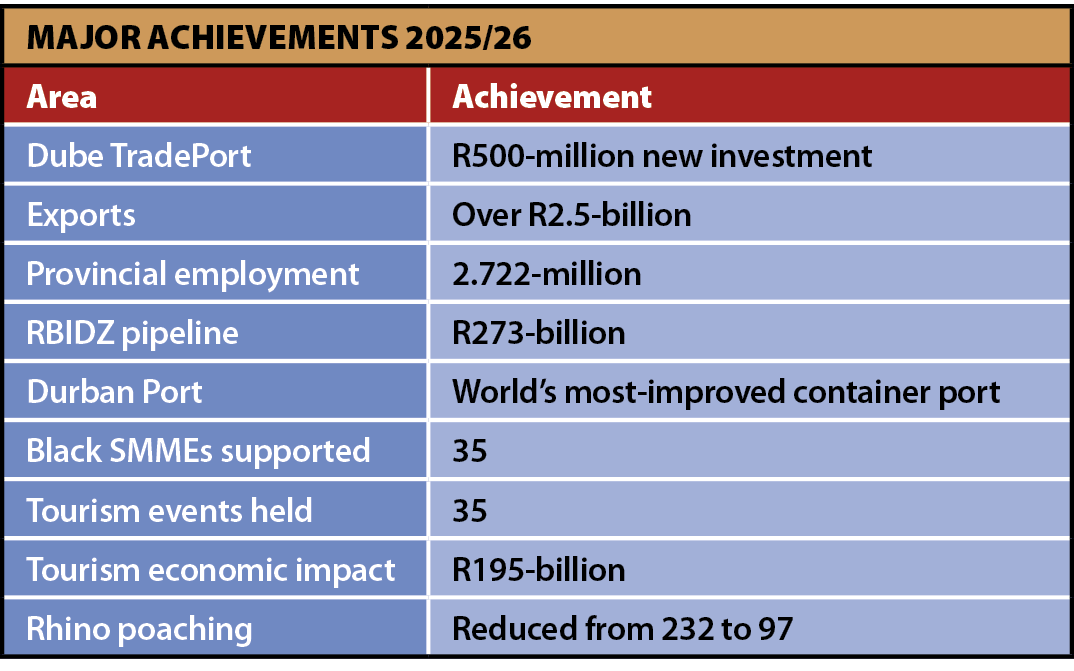
Special Economic Zones (SEZs) continue to play a central role in driving industrialisation, investment attraction and job creation in KwaZulu-Natal. During the 2025/26 financial year, Dube TradePort secured more than R500-million in new private sector investment and generated 521 new jobs, while exports through the precinct exceeded R2.5-billion.
The Richards Bay Industrial Development Zone (RBIDZ) also maintained strong investment momentum, with an investment pipeline exceeding R273-billion across approved projects in manufacturing, logistics and energy-related sectors.
The township and rural economy
Our commitment to township and rural economic development, which employs 25% of the total labour force in KwaZulu-Natal, has yielded tangible results. The KZN Informal Economy Masterplan strengthened support for informal businesses through infrastructure development, enterprise support and market-access initiatives.
Informal trading facilities completed in municipalities including Msinga, Umvoti, Umdoni and Alfred Duma have benefited hundreds of traders, the majority of whom are women and youth. The KZN Bakery Incubator has continued to support emerging township enterprises through technical training and business development, while shared chemical and detergent production facilities have assisted small enterprises with manufacturing support and product development. In February 2026, we launched the KwaMajomela Small-Scale Manufacturing Value-Add Centre in Zululand to support MSMEs in the manufacturing sector, advancing our drive to localise value chains and strengthen local economic development.
Economic regulation and transformation
The KwaZulu-Natal Economic Regulatory Authority (KZNERA) has shifted its posture from purely compliance-based regulation to market-access facilitation. In 2025/26, the authority facilitated more than 4 000 sustainable jobs and supported black-owned suppliers.
We integrated 35 black-owned SMMEs from rural and township areas into mainstream industry supply chains, unlocking R16-million in new procurement opportunities. We also strengthened the consumer protection measures through the work of the KZN Consumer Tribunal. The Department hosted the KZN Liquor Indaba 2026 which focused on liquor-trading regulation reform, enforcement of compliance and deliberations on legislation.
Enterprise support
Supporting small businesses and expanding access to economic opportunities remains central to our inclusive growth agenda. Ithala Development Finance Corporation (IDFC) continued to provide financial and business support to black-owned enterprises, youth-owned businesses and women-owned enterprises.
Innovation hubs and digital centres
The Department continued to strengthen KwaZulu-Natal’s innovation ecosystem through the development and expansion of innovation infrastructure across rural and township communities. Innovation hubs, with a combined investment of approximately R2.4-million, are improving access to digital skills, incubation support and entrepreneurial-development opportunities for young people.
Through the Moses Kotane Research Institute (MKRI), the Department also facilitated the implementation of a merSETA-funded Smart Laboratory at the Durban University of Technology (DUT). This facility enhances technical training capacity and supports the development of industry-relevant digital and engineering skills.
Investment attraction, export promotion and business retention
Positioning our province as a competitive destination for investment and trade remains central to our economic growth strategy. KwaZulu-Natal is well positioned to benefit from expanding regional and global trade opportunities through the African Continental Free Trade Area (AfCFTA) and growing economic cooperation between South Africa and China. These partnerships will strengthen exports, attract investment, support industrialisation and unlock new opportunities for manufacturing, agro-processing, logistics and job creation.
Building on the success of the 2024 and 2025 KwaZulu-Natal Investment Conferences, the secured combined investment commitments were valued at more than R185-billion, with the potential to create over 140 000 jobs.
Several strategic investments in manufacturing, logistics, tourism, infrastructure and automotive production have already moved into implementation, demonstrating growing investor confidence in the provincial economy.
Key completed projects include Toyota South Africa Motors’ vehicle production upgrade and modernisation programme, Defy Appliances’ infrastructure and equipment modernisation and Natal Portland Cement’s plant expansion. Additional developments include phases of the Westown Shongweni project and the Umdoni Point Coastal Forest Estate. Another major investment in property and tourism is the completed Club Med Resort at Tinley Manor, which welcomed its first guests in July 2026.
To strengthen investor support and improve ease of doing business, the Department also expanded the District One-Stop-Shop programme across several districts in the province.

Tourism development
During the 2025/26 financial year, a total of 35 international and domestics events were hosted, including Africa’s Travel Indaba, the Comrades Marathon and many business conferences, generating an economic impact of over R195-million.
This underscores that tourism remains a key pillar of KwaZulu-Natal’s economic growth and job creation agenda. The province continues to leverage major events such as the Amashova Durban Classic among others to drive visitor numbers, investment and local economic activity. In 2026, Africa’s Travel Indaba generated an estimated R835-million in economic impact, attracted nearly 10 000 delegates, achieved 97% hotel occupancy and supported over 1 100 jobs across the tourism value chain. With KwaZulu-Natal securing the hosting rights for the Indaba until 2030, the province is well positioned to strengthen its position as a leading tourism and business events destination while expanding opportunities for local businesses and communities.
In addition, the KwaZulu-Natal Tourism and Film Authority (KZNTAFA) and the Department continued investing in tourism infrastructure, enterprise development and skills programmes to improve the competitiveness and sustainability of the sector, while supporting the development of skilled professionals for the tourism and film industries.
KwaZulu-Natal remains one of South Africa’s leading tourism and business events destinations. Auto Week was added to the list of events hosted in October 2026, as we continue driving investment-led growth, industrial expansion and job creation across the province.
Environmental management and nature conservation
A significant milestone was the 58% decrease in rhino poaching cases in the province, dropping from 232 mortalities in 2024 to 97 in 2025, supported by the strengthened conservation, ranger support and law-enforcement interventions.
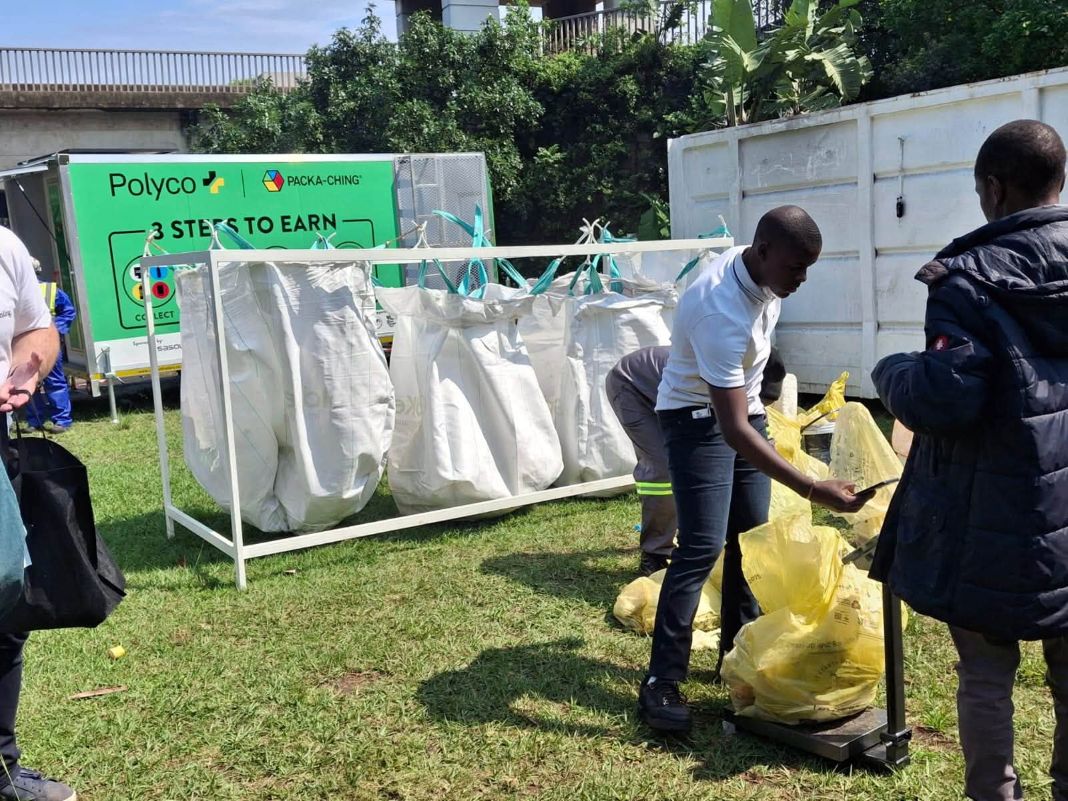
We also established the Traditional Healers’ Pharmacy at Hluhluwe iMfolozi Park and environmental programmes created employment opportunities through ecosystem restoration and land-rehabilitation projects. The province also advanced initiatives within the waste economy to promote environmental sustainability.
Strategic priorities for the 2026/27 financial year
KwaZulu-Natal Inclusive Growth Strategy. For the 2026/27 financial year, we have a new economic blueprint for KwaZulu-Natal, the Inclusive Growth Strategy, recently adopted by the KwaZulu-Natal Executive Council and formulated through the Economic Sector, Investment and Employment Infrastructure Development (ESIEID) Cluster.
Spatial economic development. In support of the secondary cities programme, the department is finalising the development of the Provincial Spatial Economic Development Strategy (PSEDS).
Industrialisation, logistics and Special Economic Zones. We will continue positioning Dube TradePort as a future-ready economic hub through strategic infrastructure investments, including industrial facilities, energy infrastructure and logistics expansion. Dube TradePort also remains focused on attracting new manufacturing investment and strengthening air connectivity.
At the Richards Bay Industrial Development Zone, several major projects in manufacturing, energy and mineral beneficiation are progressing towards implementation, reinforcing Richards Bay’s position as an emerging energy and industrial hub. Richards Bay will host the Eskom Gas-to-Power project and the Richards Bay Industrial Development Zone (RBIDZ) now has an investment pipeline exceeding R242.7-billion.
![The investment by Natal Portland Cement in extensions to its plant is a good sign for the regional economy. [Photo: Top Dog Construction]](https://www.globalafricanetwork.com/wp-content/uploads/2026/10/JOAB_November_2026_-_Article_3628_-_simuma_expansion_project_at_NPC_by_Top_Dog-900x1200.jpg)
Infrastructure development. Support for strategic infrastructure programmes includes the Road-to-Rail strategy, improvements in freight and logistics infrastructure and advocacy for high-speed rail connectivity between Durban and Johannesburg. We are also investing in airport infrastructure, industrial facilities and agro-processing initiatives.
Projects which will receive support include the Prince Mangosuthu Buthelezi Airport (Zululand District), Mkhuze Airport (uMkhanyakude), Richards Bay Airport (King Cetshwayo), Madadeni Clothing and Textile IEH Incubator (Amajuba) and the Fresh Produce Agrihub (RBIDZ).
Township and Rural Economies Revitalisation Strategy. The Township and Rural Economies Revitalisation Strategy (TRERS) underpins the strategy of investing in informal-trading infrastructure, township-enterprise development and small-business support, including the development of trading facilities, market infrastructure and manufacturing support programmes. Through strategic partnerships, we will also support township businesses with digital tools, market access and bulk-buying support.
Small-business development and sector transformation. Small businesses remain at the centre of our inclusive-growth agenda. We have budgeted R11-million for shared manufacturing facilities for chemicals and detergents, expanding our successful model. Programmes include the KZN Bakery Incubator’s mentorship and skills development programmes and targeted support for the cannabis and hemp sector. Programmes supporting music, business-process outsourcing and innovation-driven enterprises will continue.
Tourism and cultural heritage. Tourism remains a strategic pillar of provincial development. In Zululand, the Thokazi Royal Lodge and the Somkhanda Game Reserve will be refurbished. In uMkhanyakude, Hilltop Camp will be upgraded. Auxiliary studies for the Drakensberg Cable Car in uThukela District are being fast-tracked.
We are investing in tourism entrepreneurship, skills development and service-excellence programmes. An integrated Culture, Heritage, Investment and Tourism Strategy is being developed. The Enyokeni Dome and Precinct will continue to be positioned as a strategic cultural and tourism asset.
Environmental stewardship, climate resilience and biodiversity management. Through our Invasive Alien Species Programme we will create 2 248 EPWP job opportunities while restoring and protecting critical ecosystems. We will also continue supporting climate adaptation initiatives, environmental management programmes and waste-economy interventions. Ezemvelo KZN Wildlife will continue implementing a zero-tolerance approach to wildlife crime while advancing its commercialisation strategy to enhance tourism experiences within protected areas.
Driving delivery in the real/productive economy
EDTEA entities
KwaZulu-Natal Growth Fund Agency. The KZNGFA is pivotal in advancing broad-based black economic empowerment through large-scale infrastructure and manufacturing projects. In the coming year, high-impact projects include Jozini Retail Centre in uMkhanyakude District, Mobile Hemp Processing at King Cetshwayo District, the Madadeni Distribution Centre in Amajuba District and the Ndwedwe Mall in iLembe District.
Ithala Development Finance Corporation. The IDFC continues to serve as our flagship developmental finance platform. In the 2026/27 financial year, the corporation has budgeted R176-million for lending to SMMEs and co-operatives and R117-million for investing in asset revitalisation. In partnership with private sector investors, the IDFC will implement three major catalytic projects relating to shopping centres and alternative energy with an investment value of R865-million.
Ithala SOC. Ithala SOC remains an important institution in our efforts to expand access to development finance and support economic participation. The institution continues to face significant financial and governance challenges, including the withdrawal of its banking licence and broader constraints that have impacted its sustainability. A new Accounting Authority has been appointed and Ithala SOC now falls under the IDFC.
KwaZulu-Natal Economic Regulatory Authority. KZNERA is a critical revenue generator. The authority will facilitate 5 846 new job opportunities through sector expansion and licensing and will launch a fully integrated digital licensing portal to reduce administrative red tape and prioritise youth and rural entrepreneurs. KZNERA will also roll out unannounced compliance inspections to 5 000 operating sites to protect our communities.
Trade and Investment KwaZulu-Natal. TIKZN remains our lead agency for inward investment and export promotion. Through targeted investment promotion initiatives and the expansion of District One-Stop Shops, TIKZN will continue strengthening investor support and improving the ease of doing business.
Moses Kotane Research Institute. The MKRI provides the policy intelligence and innovation support necessary for an evidence-based developmental state.
Regulatory governance and consumer protection. In 2026/27, we will finalise the KZN Business Bill, which seeks to modernise the provincial licensing framework, reduce red tape and improve compliance. Through the consumer protection sub-programme, we will undertake the Consumer Ambassadors Programme, creating work opportunities for 20 unemployed graduates.
A future of shared prosperity
This budget is rooted in urgency and driven by our commitment to deliver meaningful change in the lives of people of KwaZulu-Natal. From the informal trader in our townships to the entrepreneur in our secondary cities, from our farmers in rural communities to investors creating jobs across the province, this budget is about ensuring that economic opportunity reaches every corner of KwaZulu-Natal.
To the business community, thank you for your continued support, investment and confidence in our province. Your commitment to innovation, growth, and social responsibility drives our economy forward.
As we move forward, let us embrace the challenges with boldness and the opportunities with hope. Together, we have the strength to build a thriving and resilient KwaZulu-Natal. And I quote the words of the late Prince Mangosuthu Buthelezi, “leadership is not about power; it is about service to the people.” This budget gives practical expression to the 7th Administration’s commitment to taking the economy to the people and ensuring that no one is left behind.
The budget we table today reflects our commitment to prioritise delivery arms and catalytic programmes.