
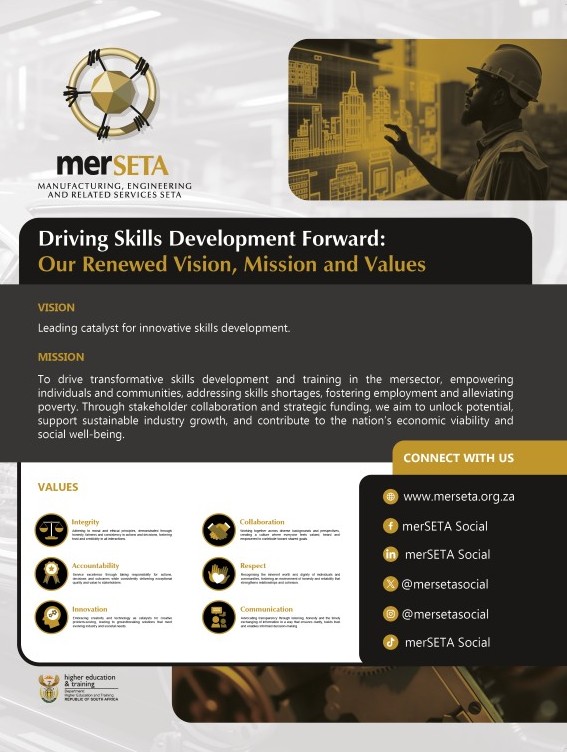
These conversations with the Management Committee explore how leadership intends to embed the new VMV into everyday decision-making while positioning the merSETA (Manufacturing, Engineering and Related Services SETA) as the leading catalyst for innovative skills development.
Renewing the merSETA
The merSETA recently unveiled its new Vision, Mission and Values. What does this milestone represent for the organisation?
For many years we’ve been seen as the leaders in closing the skills gap and we knew that Vision needed a revamp because the environment has really changed. The type of people we’re serving have a different expectation to what they used to have. So it was very important for us to renew our strategic objective. Therefore it became critical for us to renew our Vision, Mission and Values.
It’s important to renew the organisation and also to make sure that we meet the expectations of our stakeholders, whose expectations have evolved over time based on the economic outlook and the environment.
The new Vision positions the merSETA as a “Leading catalyst for innovative skills development”. What does this Vision mean from your perspective, and how does it influence the way we serve our stakeholders?
The manufacturing, engineering and related sectors have a lot of technological advancements which have changed drastically. Manufacturing processes have changed due to the Fourth Industrial Revolution and those technologies needed us to think of how we serve them, especially with the skills that they require based on those technological advancements.
Being a leading catalyst for innovative skills development talks to the innovation that you see in the manufacturing sector, so it’s critical that we remain innovative. We serve our changing environment and stakeholders with the required skills that are in sync with the innovation that we see in the sector.
The new Values emphasise Integrity, Collaboration, Accountability, Respect, Innovation and Communication. Which of these Values resonates most with your leadership style and why?
Integrity comes out very high because we have to serve our clients with integrity. Our clients and stakeholders must look at us and say the merSETA leadership have that integrity and therefore we can trust them to serve us well. The second important one is communication.
We are serving the stakeholders, so we must find innovative ways of communicating with them continually and that communication has changed due to technology and social media. We’re using all those channels to enhance our communication. So for me the value of communication resonates very well with my leadership style because we have to be available to our clients. We have to communicate with them. They shouldn’t be asking questions. We should be answering the questions before they ask them. So those two come top for me.
Embedding organisational Values requires commitment from everyone. What practical steps do you believe employees can take to ensure the VMV becomes part of our everyday culture rather than simply words on paper?
I have initiated what we call Town Hall sessions to try to communicate with the staff because we want them to collaborate with us as leadership and not see it as us and them. So in the Town Halls we make sure that we communicate these Values and we try to promote them in terms of them buying into these Values and therefore developing a new culture of the organisation. It also gives them a platform where we are able to detect if there are any uncertainties or concerns, and then they are able to talk freely to us as leadership. We make it a safe space to communicate with all staff members and we always call for collaboration.
The merSETA belongs to all of us as staff members and therefore we can collaborate with our clients much better. So that’s what I drive in order to change culture.
How do you envision the new VMV strengthening relationships with employers, industry partners, government and training institutions?
In our Vision we are saying we are a leading catalyst for innovative skills development. This innovation obviously is more external and we need to respond to it promptly. We also recognise that what we do in facilitating skills development has the challenge that the environment is highly regulated. We have to understand the innovation out there. Collaboration with employers is very important to us. We are calling on them to tell us, “What are the changes that you are facing as organisations, as industry, that we need to respond to with skills?” We are relying on that collaboration with employers, especially employer associations.
Government is faced with the challenge of high unemployment; the majority of the youth are unemployed, but the government can’t provide jobs, so we say to government, “How can we help you? How can we collaborate with you?” And we recognise that with the changing environment of occupational programmes that we offer.
We need to communicate with the training institutions, the skill development providers from TVET colleges and higher education institutions, universities and so on. We say to them, can we collaborate and make this happen? We cannot have graduates trained but somebody says they do not have the skills that I need to employ them. We must train people for possible employment and not for unemployment. So we must find a way to bridge that gap through collaboration.
How do you see the renewed Mission strengthening merSETA’s contribution towards addressing skills shortages, creating employment opportunities and supporting inclusive economic growth?
It is relevant to address those key priorities and also the kind of expectation that we have because by renewing the organisation we are no longer doing what we used to do in the past. We want to do something new that is relevant to the changing environment. We are often called to deal with high unemployment of the youth and those who are not even in education and training programmes, so there’s always a call for us to respond to that. But the call also says we must respond through supporting programmes that will make them employable or self-employable.
So the call for addressing entrepreneurial skills becomes heightened and we are asked to train them. We shouldn’t just be talking about the number of learners that have been trained during a particular financial year, we must also try to measure whether the training was impactful, whether some of those learners were absorbed and hence we always call for collaboration with industry partners to help us to get these learners into workplace-based learning programmes.
What message would you like to share with merSETA employees as we collectively embrace this new organisational direction?
My message is that we are renewing an organisation that had lagged behind over time, and the new Vision, Mission and Values are intended to bring it into the present. My call is for employees to live the Values of the merSETA. We want them to know that we need to be accountable, not only accountable to our shareholder or the Department of Higher Education and Training, but also to the public.
The scrutiny on SETAs has become heightened and every staff member needs to contribute to making the impact that SETAs need to make so that we are seen as being part of the winning team. Together everyone will achieve more, and therefore each and every employee in the organisation does matter. My message to them is to say they need to make sure that they are contributing to the bigger organisational objective. They must understand that with every small activity or task that they perform, there is a person on the other end who’s hoping to get a certificate issued, and even have an expectation of an allowance being paid for them to make a living.
So whatever we do, that document that you move from one folder to the other, it has a person behind it. And that person is anxiously hoping for an impact in their life.
What capabilities or mindsets will be most important for merSETA employees to develop as it pursues its renewed Vision?
I think we’ve done fairly well with people development as our staff does get training, but we often concentrate more on personal development. I think we need to look at the impact that the personal development initiatives are giving our staff members to develop themselves. How does that feed back into changing the organisation and filter through to our Vision as the organisation? What is the impact that we get from the kind of personal development initiatives that the employee benefits from? I think the way forward for us is to have a focused attention to promotion of Vision, Mission and Values. We’ve done it, but it can’t be a once-off activity. We need to continually get them on board and renew it.
What legacy would you like this renewed organisational direction to leave for South Africa’s skills development?
One thing that fulfils me is to meet somebody at a company who is qualified and working and when they hear that I come from the merSETA, they tell me they got a bursary from the merSETA that helped them to study engineering and now they are qualified and working in an organisation that is linked to the merSETA. We want to hear people in the manufacturing and engineering sector say that the merSETA touched their lives by improving their skills to be where they are now. That’s the legacy that the merSETA should have from this renewed Vision, Mission and Values rebrand.
If you could describe the merSETA’s future under the new Vision, Mission and Values in three words, what would they be and why?
Impactful, relevant and making a difference. That’s what I would want us to do as an organisation.
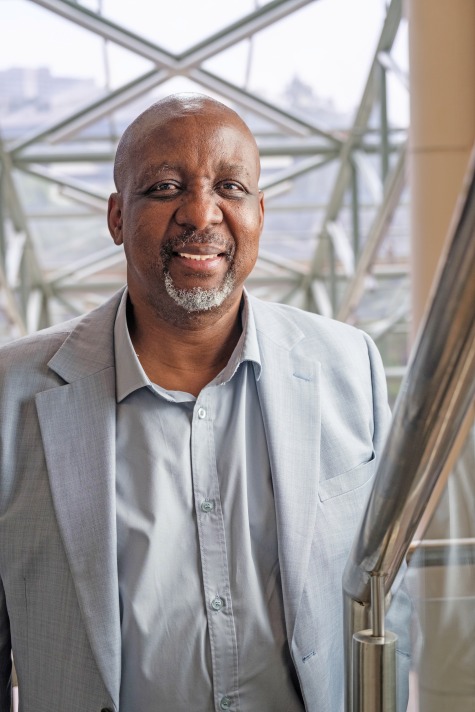
| Biography Mr Naphtaly Mokgotsane, Acting Chief Executive Officer Naphtaly Mokgotsane’s career is firmly rooted in the manufacturing, engineering and skills development landscape. After completing an automotive apprenticeship soon after finishing school, he gained first-hand experience of the technical training environment and the realities of South Africa’s industrial sector. He went on to spend six years in the Technical and Vocational Education and Training (TVET) college sector, where he taught and later became a subject head. His work in this environment strengthened his understanding of curriculum delivery, training systems and the needs of young people entering technical fields. Mokgotsane later joined the Department of Labour, within the National Artisan Development Chief Directorate (INDLELA), the unit responsible for artisan development in South Africa and which now forms part of the Department of Higher Education and Training. His role focused on building the capacity of Sector Education and Training Authorities (SETAs) for artisan training. These experiences prepared him for his next chapter at the merSETA, where he initially took responsibility for quality assurance. Over the past two decades, he has steadily advanced through several leadership roles, including positions overseeing quality assurance, programmes and strategic partnerships with institutions of higher learning. His long-standing commitment and proven leadership led to his appointment as Acting Chief Operations Officer for more than a year, and subsequently, in March 2024, he was named Acting Chief Executive officer of the merSETA. |

Translating strategy into sustainable outcomes
The merSETA recently unveiled its new Vision, Mission and Values. What does this milestone represent for the organisation?
The launch of our renewed Vision, Mission and Values is more than a branding exercise; it represents a strategic commitment to the future of skills development in South Africa. It provides a clear sense of purpose and direction for the organisation while reaffirming our commitment to serving the manufacturing, engineering and related services sectors. It creates a shared understanding of who we are, what we stand for and how we intend to create value for our stakeholders.
Importantly, it positions the merSETA to respond more effectively to emerging economic, technological and workforce challenges while remaining focused on our mandate of developing skills that drive inclusive growth and industrial development.
The new Vision positions the merSETA as a “Leading catalyst for innovative skills development”. What does this Vision mean from your perspective, and how does it influence the way you serve your stakeholders?
Being a leading catalyst means going beyond funding skills development programmes. It means actively enabling partnerships, innovation, research and interventions that anticipate future industry needs. As a catalyst, the merSETA should be accelerating change by bringing together government, industry, labour and training providers to develop skills solutions that are relevant, impactful and sustainable.
From a financial perspective, this Vision challenges us to ensure that every rand entrusted to the organisation is directed towards interventions that create measurable value, strengthen industry competitiveness and improve employment outcomes. It requires us to be forward-looking, data-driven and responsive to the needs of our stakeholders.
The new Values emphasise Integrity, Collaboration, Accountability, Respect, Innovation and Communication. Which of these Values resonates most with your leadership style and why?
Accountability resonates most strongly with my leadership style. As CFO, I have the responsibility of ensuring that public resources are managed responsibly, transparently and in compliance with legislative requirements. Accountability means taking ownership of decisions, being transparent about outcomes and ensuring that commitments are translated into action. However, accountability cannot exist in isolation. It must be supported by integrity, collaboration and open communication.
I believe that effective leadership is about creating an environment where people feel empowered to take responsibility while working collectively towards the organisation’s goals.
How will the Finance Division ensure that the merSETA’s financial resources are aligned with delivering on the renewed Mission and strategic priorities?
The Finance Division plays a critical role in translating strategy into sustainable outcomes. Our responsibility is to ensure that financial planning, budgeting and resource allocation directly support the organisation’s strategic objectives and the priorities outlined in our Mission. This means adopting a strategic budgeting approach that prioritises programmes with the highest developmental impact while ensuring sound financial governance and compliance. We will continue to strengthen performance-based resource allocation, enhance financial monitoring and provide management with timely information to support evidence-based decision-making.
Ultimately, our goal is to ensure that every financial decision contributes towards empowering individuals, strengthening industry competitiveness and advancing South Africa’s skills development agenda.
If you could describe the merSETA’s future under the new Vision, Mission and Values in three words, what would they be and why?
- Innovative – because we must continuously evolve to meet the demands of a changing economy and workforce.
- Impactful – because our ultimate success is measured by the difference we make in the lives of individuals, employers and communities.
- Trusted – because integrity, accountability and excellence form the foundation of sustainable stakeholder relationships and organisational success.
Together, these three words capture my vision of a merSETA that leads with purpose, delivers meaningful outcomes and remains a trusted partner in shaping South Africa’s skills development future.
| Biography Mrs Disa Mpande, Chief Financial Officer (CFO) Mrs Ncedisa Mpande is a seasoned executive with over 15 years of experience in various industries, possessing a strong track record of leadership, sound financial management and a passion for driving strategy and business growth. She is a Chartered Accountant (CA(SA)) with a Bachelor of Commerce degree from the University of Cape Town. She holds a Post Graduate Diploma in Accounting and CTA from the University of KwaZulu-Natal. She currently holds the position of Chief Financial Officer at the merSETA, where she has implemented a turnaround strategy that includes improved organisational performance, transformation and a marketing strategy that has successfully turned around the organisation’s image. |
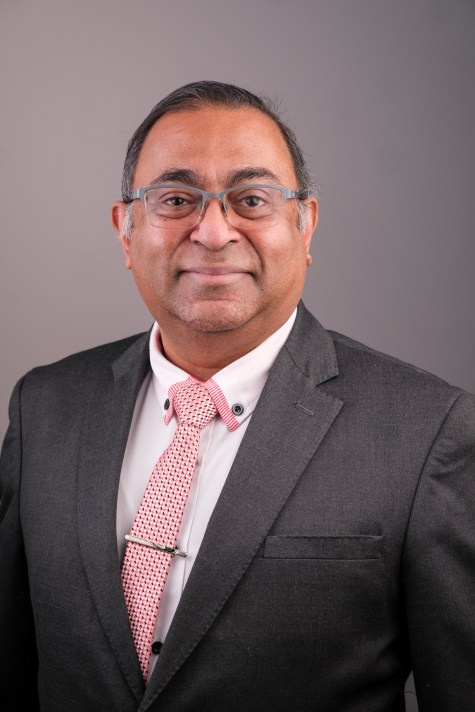
Shaping a new culture
The merSETA recently unveiled its new Vision, Mission and Values. What does this milestone represent for the organisation?
When we really looked at our Vision, Mission and Values, we were wanting to rebrand the organisation, and what really stood out was that there’s been a lot of change in the manufacturing and engineering sector. And a lot of that change is driven by innovation such as robotics and the 4IR environment, artificial intelligence, and virtual and augmented reality which were becoming a standard in the industry.
In response to these changes, the merSETA needed to ask itself, “How are we still relevant in terms of that evolving landscape?” That underpinned the need to really look at the Vision, Mission and Values.
The new Vision positions the merSETA as a “Leading catalyst for innovative skills development”. What does this Vision mean from your perspective, and how does it influence the way you serve your stakeholders?
You normally add in a catalyst if you want a reaction because it stimulates and accelerates things, so this symbolises that we no longer want to be a passive organisation. We want to be actively involved, to commit, to bring in solutions that close the skills gap. The innovation part is speaking to raising expectations, not just being responsive to them. Being agile enough to make that impact on learners and training providers, but to be influential and to inject opportunity, enable employment in the sector and boost productivity.
The new Values emphasise Integrity, Collaboration, Accountability, Respect, Innovation and Communication. Which of these Values resonates most with your leadership style and why?
My journey is in the corporate space, so I take care of the organisation’s human resources. I look after its facilities, making sure we have a home to do our work from and that we are able to deliver the services we are mandated to deliver, so that we can build an organisation that has passionate people. At the heart of any organisation you need your people to be committed. We hire people who have the capability, but then we need to grow and nurture that talent so that they are enabled and empowered in order to make a difference in other people’s lives.
What excites me about the new VMV is that it really brings in that element of initiative, of expectation, of leadership, of support, of better communication and collaboration. It’s about making an impact, and I think this new approach of doing things in the organisation is ready to be impactful.
Embedding organisational Values requires commitment from everyone. What practical steps do you believe employees can take to ensure the VMV becomes part of our everyday culture rather than simply words on paper?
As a leadership group we need to live the new Values ourselves. We have to be seen to have incorporated these Values into our day-to-day work. Then we must recognise others who are living up to the Vision, Mission and Values of the organisation through accolades and recognition. It’s important to create an enabling environment for that to happen. We need to give people the tools they need and to relook at how we delegate certain areas of work, empower decision-making, but empower people with the tools so they are able to make those decisions. We need to shape a new culture, encourage it and create an environment which can foster and grow our talent.
If you could describe the merSETA’s future under the new Vision, Mission and Values in three words, what would they be and why?
I would like to think that the new VMV will bring more integrity into the things that we do. So when we say something, we actually do it. This also means being responsible for what you’ve been entrusted with. So we need to act with integrity. I think that’s the key word.
The other word is to be more resilient. Never give up, persevere and get the result you want. So let us be resilient, let us make sure that we can be impactful. If I had to think of a third word, it would be let’s live what we do. If we’re talking about skills development, let us also develop our skills. Empower ourselves. Training and development is not just for other people. There should never be a day where you stop learning. Be committed to lifelong learning.
| Biography Dr Rajesh Jock, Corporate Service Executive After completing a BCom degree, Dr Rajesh Jock joined the clothing and textile manufacturing industry, working in the marketing department but focused on quality assurance. His interactions with the company’s clients taught him how to build those relationships and provide good customer service, which led into the field of communication. Today, at the merSETA, he heads up the communication and marketing portfolio. He later left the private sector to take up a role in government, where he served as head of transformation. This led him to advance his studies in the field of HR. He also holds a postgraduate qualification in company law, with the merSETA’s Legal Services reporting to him. |

Aligning operations with stakeholder needs
The merSETA recently unveiled its new Vision, Mission and Values. What does this milestone represent for the organisation?
I head up operations and the new VMV tells us that it’s actually a reset for the organisation. We’ve had all the pieces in place for a while, but not always pulling in the same direction, so this gives us a common baseline or a common line of sight of where things should be going and what we need to do in order to ensure that we are going in the right direction.
It’s more about enforcing alignment, and within the operations sphere, which deals with regions, client services and grants management, if we’re not pulling together, we will not produce anything meaningful.
The new Vision positions merSETA as a “Leading catalyst for innovative skills development”. What does this Vision mean from your perspective, and how does it influence the way we serve our stakeholders?
Our organisation is mainly involved in grant funding as well regulating skills development within our sector, but what we’re seeing is that this is not enough any more. We cannot just sit back and say we fund and we regulate.
This particular Vision pushes us to be more hands-on in how we get things delivered to our stakeholders by making sure that the programmes we provide respond specifically to what industry needs. It can’t be the same as business as usual in terms of what we have been offering. From an operations side, it’s about fixing our systems and processes, and making sure those processes respond specifically to our stakeholders’ needs. We have to be hands-on and deliberate about our actions.
The new Values emphasise Integrity, Collaboration, Accountability, Respect, Innovation and Communication. Which of these Values resonates most with your leadership style and why?
I resonate more with the accountability value theme. If people are not clear on what they are responsible for, then there’s no consequence when things slip up.
As an organisation, we’ve seen over the years that accountability alone is not enough, and it’s important that people talk to each other, share information and solve problems. That’s where collaboration and communication meet accountability. For operations at merSETA, people need to know what to do, tasks are assigned and those people can be held accountable for delivery.
Innovation is now one of the merSETA’s core Values. How do you see innovation improving operational efficiency and stakeholder experience?
It’s important that we acknowledge that too much of our work is still reliant on heavy manual as well as repetitive tasks. Innovation in our space is really about fixing what slows us down, digitising processes that shouldn’t be manual any more, and getting better visibility in terms of what’s happening in real life. We need to tap into the available technologies. For example, we’ve recently acquired a virtual site visit platform, which allows us to connect directly with stakeholders.
What operational improvements can stakeholders expect to see as the organisation aligns its systems and processes with the new VMV?
From an operations perspective I think the biggest difference will be around consistency, particularly at regional level. Before the implementation of the new VMV, processes or experiences varied region by region, possibly function by function, and sometimes even by depending on who you’re dealing with, and that’s what we need to eliminate. Stakeholders should see that the same process is applied across the board – in merSETA offices in Durban or in the Western Cape.
If you could describe the merSETA’s future under the new Vision, Mission and Values in three words, what would they be and why?
One of the words I would use is resilient. The second one would be aligned to what we’ve been discussing, which is to be innovative. And we need to take accountability for the decisions we make.
| Biography Mr Mthunzi Lubando, Acting Chief Operating Officer Mthunzi Lubando is a seasoned executive leader with over 15 years of experience in South Africa’s skills development sector, built entirely within the Manufacturing, Engineering and Related Services Sector Education and Training Authority (merSETA). He leads the organisation’s largest functional division spanning Learning Programmes & Quality Assurance, Grants Management, Client Services and Regional Operations across all nine provinces. Mthunzi holds a Master of Business Administration (MBA) and a Post-Graduate Diploma in Business Administration from Wits Business School. His academic grounding includes a Global Executive Leadership Programme through the Howard University School of Business. |
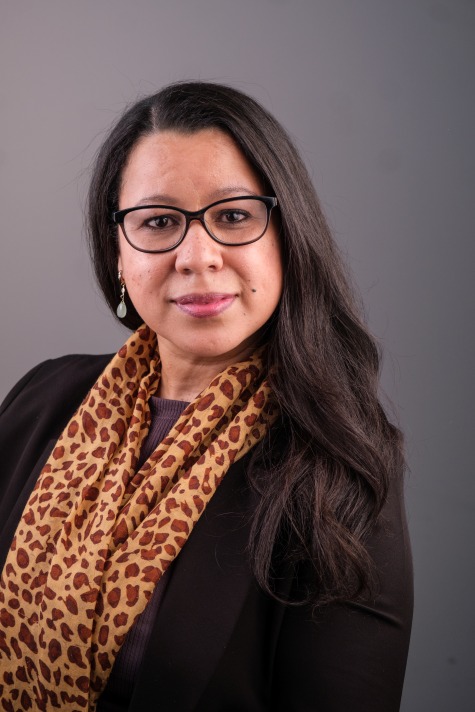
Thought leadership, innovation and action
The merSETA recently unveiled its new Vision, Mission and Values. What does this milestone represent for the organisation?
We were actually instrumental in driving the need to actually change the Vision, Mission and Values because my department developed the documents and we worked with HR. What it means for us is that we really do move from being just a compliance-driven organisation to one that is making an impact and a lot of the time people will look at government agencies to say, “Well, your role is legislated, so you just need to do what you get told to do.”
Firstly, we need to do it well, and secondly, we need to really look to the future to see how we are going to make an impact given all the problems we have in South Africa. So in our little way we need to make sure that we do what we say we’re going to do and make our clients believe it too.
The new Vision positions merSETA as a “Leading catalyst for innovative skills development”. What does this Vision mean from your perspective, and how does it influence the way we serve our stakeholders?
The word catalyst means to spark something, to ignite something and then, once there’s a spark, you will get a big explosion, and it’s about innovation. So to be a leading catalyst for innovation and skills development means that we need to take on that opportunity to find innovative ways of being that skills intermediary that’s going to make a difference, not only for the learners and for the people who are employed in the sectors, but for the companies themselves.
The new Values emphasise Integrity, Collaboration, Accountability, Respect, Innovation and Communication. Which of these Values resonates most with your leadership style and why?
I think they all have to resonate with you because they are personal traits that we should have anyway. In the merSETA space, collaboration is key as we can’t develop skills in the way that you might run a business. We can’t buy stock and sell stock for profits. That’s not how it works. We can’t develop a human being and put them into the market and expect them to find a job and then do good work in that job.
We need to work with industry and with the education system and government to find ways of developing skills aligned to projects that are going to help people end up somewhere meaningful. You’ve heard the term “training for unemployment” – we don’t want to be doing that. We want to enable our learners to have skills that are saleable in a market that is very constrained.
The manufacturing sector is changing rapidly. How will strategic research ensure that the merSETA remains responsive to emerging technologies and trends?
We partner with credible research partners and also have an in-house team of researchers that are very talented. Through the Sector Skills Plan and our research projects we try to anticipate the emerging skills, but it’s not as simple as that. If you speak to employers and ask them how their occupations are changing, they often don’t know because the economy right now is so stagnant and business owners, especially small business owners, are so risk averse and are not willing to invest in new technologies. They’re also not willing to invest in more labour.
There are incentives for hiring youth… but when you hire youth they don’t have the skills to be able to drive the company forward. So we’re caught between a rock and a hard place, but I believe that the research we do is highlighting these issues. How we actually take the research recommendations forward innovatively is something that we are also trying to work on with our board members.
We have a new board now, so it’s about gaining their trust in the research and data to then develop projects and programmes that are going to innovate.
If you could describe the merSETA’s future under the new Vision, Mission and Values in three words, what would they be and why?
I think it would be thought leadership, innovation and action, because at the end of the day we must implement it as well.
| Biography Ms Laura Harris, Acting Executive: Strategy Research and Reporting Laura Harris is a seasoned research, demography and corporate strategy executive with over two decades of experience driving socio-economic development, labour market intelligence and national skills frameworks across South Africa. At the merSETA, she directs macro-level strategic planning, operational budgeting and the production of the Sector Skills Plan (SSP) to align national human capital with industrial demand. Laura holds a Master of Arts in Demography and Population Studies from the University of the Witwatersrand, alongside specialised certificates in Advanced Demographic Methods and Longitudinal Data Management. |
Visit merSETA online: https://www.merseta.org.za/
The Journal of African Business
The Journal of African Business is a unique guide to business and investment in Africa. The quarterly journal covers a broad range of topics, ranging from energy, agriculture, manufacturing and mining to tourism and skills development.