
Election Timetable
With the proclamation now in effect, the Commission has, as required by the Local Government: Municipal Electoral Act 2000 and Regulations, published the 2026 Local Government Elections timetable in the Government Gazette. The Election Timetable marks the formal commencement of the electoral process, providing legal certainty and operational clarity to all electoral stakeholders, including political parties, independent candidates, voters, the media, civil society organisations and election administrators.
The timetable outlines the key milestones, statutory deadlines and compliance requirements that govern the conduct of the elections, ensuring that every phase of the process is undertaken in accordance with the Constitution and the applicable electoral legislation. As the lodestar for the electoral programme, the Election Timetable guides preparations ranging from the finalisation and certification of the voters’ roll for these elections, candidate nominations, objections and appeals, voting arrangements, special votes and the declaration of results. It provides equal opportunity for all contestants to participate in a transparent, free and fair electoral process while promoting accountability and certainty throughout the election period.
All activities prescribed in the Election Timetable must be completed by 17h00 on the respective cut-off dates.
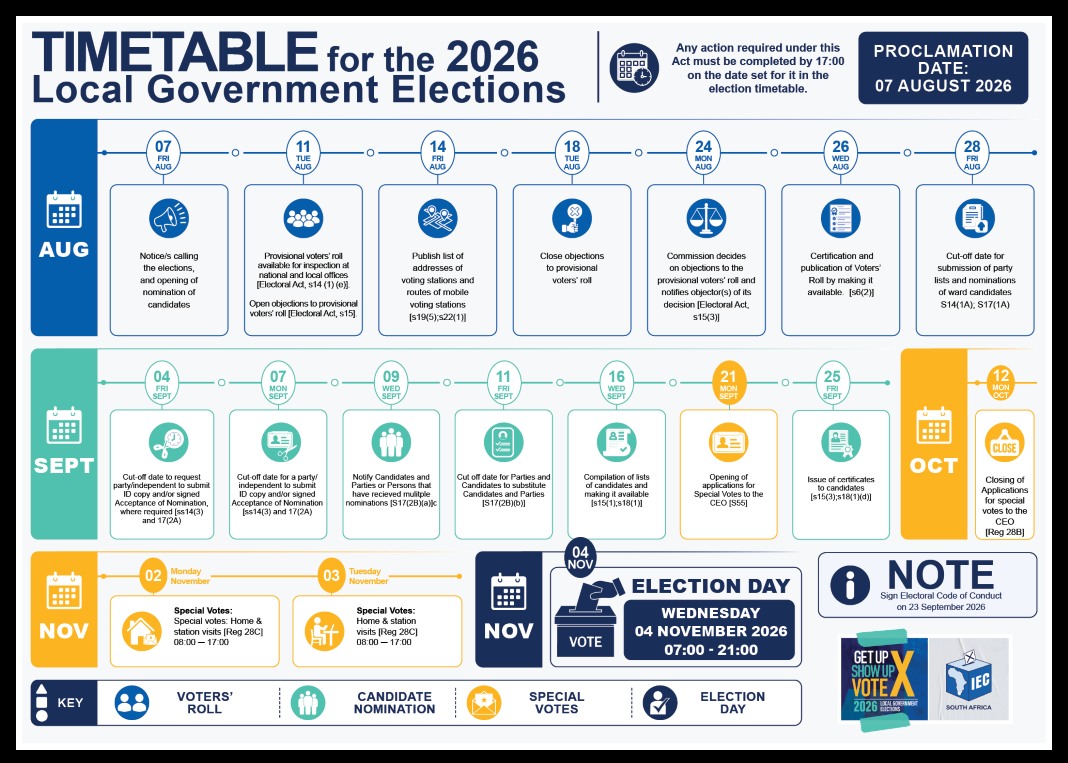
Key activities that underpin the Election Timetable
Inspection of the provisional voters’ roll
The most immediate consequence of the proclamation is that the voters’ roll closed at midnight on 7 August 2026. Once the voters’ roll closes, no new voter registrations or changes to registration details are accepted for the 2026 Local Government Elections.
The Commission has made the provisional voters’ roll available for inspection at its national, provincial and local offices. This opened the period for lodging objections to the provisional voters’ roll. The Commission reviewed all objections and notified objectors. The final voters’ roll for the 2026 Local Government Elections was published on 26 August 2026 and electronic copies provided to certified contestants.

Update on the registration drive
The Commission’s investment in digital technology continues to yield positive results by improving access, convenience and efficiency in electoral services. Since the second registration weekend, where 1 794 051 registration transactions were recorded, the Commission reports an additional 210 734 transactions, bringing the total number of voter interactions recorded during this registration period to two-million.
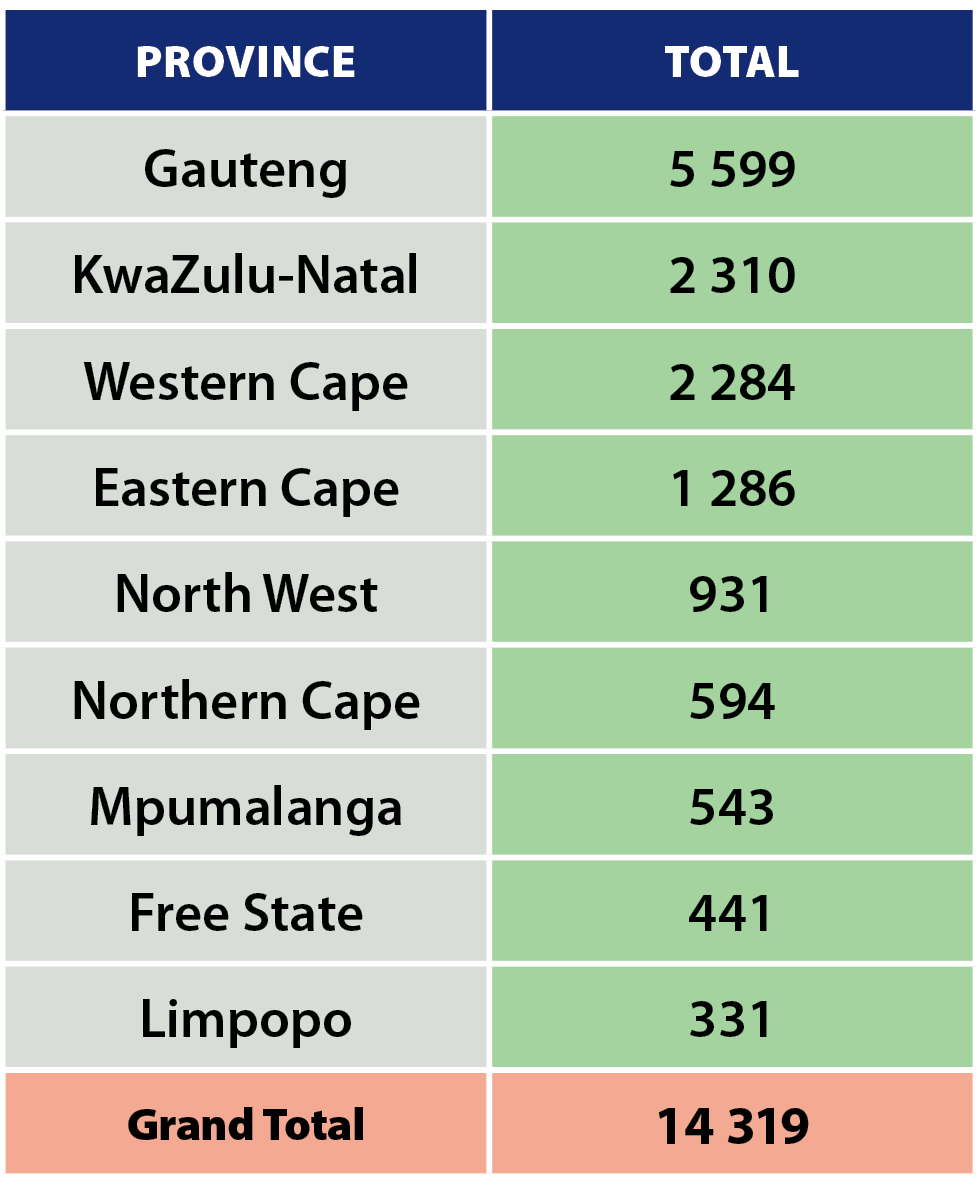
The largest number of new registrations were recorded in Gauteng, with 14 649.
The introduction of the data-free online voter registration portal has provided relief to South Africans by removing data costs as a barrier and enabling eligible voters to register or update their details remotely.
Additionally, the introduction of the WhatsApp voter registration channel represents another significant innovation, expanding access to millions of South Africans by providing a convenient, secure and user-friendly platform to engage with the voter registration process.
Since its launch on Monday, 3 August 2026, over 14 000 registrations have been recorded on WhatsApp. The provincial breakdown is as follows:
Publishing of the list of voting stations
In the interest of transparency regarding voting stations, the Commission published the list of voting stations with their addresses on 14 August 2026. The publication of the list of
voting stations included the routes of mobile voting stations. There are 32 mobile voting stations across the country. The publication of voting station details enables voters to confirm the location of their designated voting stations and assist communities served by mobile voting stations to plan accordingly ahead of Election Day.
Candidate nominations
Candidate nominations officially closed on 28 August 2026 and the Commission published the final list of successful candidates on 16 September 2026. Successful candidates were issued certificates of candidacy on 25 September 2026. To expedite and facilitate the nomination process, the Commission opened the OCNS on 21 June 2026. The early opening of this portal assisted political parties and prospective independent candidates in capturing candidates’ and supporters’ information ahead of the formal nomination period.
By law, registered political parties and independent candidates intending to contest elections must pay monetary deposits. The deposit confirms the intention of the contestants to participate in the election. In other words, the functional value of the election deposit is to ascertain the seriousness of the intention to contest. Deposits are refundable to contestants who obtain at least one seat in the applicable proportional representation (PR) election, or who obtain at least 10% of the valid votes cast in the applicable ward election. If a contestant loses, the deposit is not refundable and is forfeited to the National Revenue Fund. The required deposits are:
- R4 700 in an election in a Metro (covers all PR and ward candidates of a party)
- R2 800 in an election in a Local Council (covers all PR and ward candidates of a party)
- R1 800 in an election in a District Council (covers all PR candidates)
- R1 800 for an independent ward candidate or in respect of each party ward candidate if the party is not contesting the PR election
- Total if contesting all municipalities: R693 600
Political contestation
The register of political parties currently stands at 674 registered parties, reflecting the depth and diversity of political participation in South Africa. Of these, 330 are registered at national level, 32 at provincial level, 257 at district level and 55 in metropolitan municipalities. The high number of district-level parties highlights the expected political contestation in local government elections at community level.

Special votes
The Election Timetable makes provision for citizens who are unable to present themselves physically at their voting stations on Election Day due to physical limitations, illness, disability or other circumstances, to apply for a special vote. The opening of applications for special votes opened on 21 September 2026 and closes on 12 October 2026. Voters applying for special votes must indicate whether they must be visited in their homes or places of care, or at the voting station of registration on 2 or 3 November 2026.
Special votes are an important feature of our electoral scheme because they ensure that eligible voters in special circumstances are not excluded from participating in the electoral process. Thus, special votes promote electoral inclusivity.
Applications for special votes may be submitted through the following channels:
- Visit the Electoral Commission website to complete an online application for a voting station visit or home visit.
- Download the special vote application form from the Electoral Commission website or obtain a form from a local IEC office during office hours. Completed forms must be hand delivered to the relevant IEC office. Registered voters can apply for a voting station special vote by SMSing their identity number to 32249 (R1.50 per SMS).
Electoral Code of Conduct
Another key milestone triggered by the election timetable is the Electoral Code of Conduct. The Code of Conduct is now effective following proclamation. The Code sets the standards for political parties, candidates and other participants, promoting a free, fair and peaceful electoral process. Ahead of these elections, the Commission will also imminently promulgate an additional code on the measures to counter disinformation. This additional code will foster the creation of information integrity, which is a crucial aspect for the delivery of free and fair elections.
Get Up. Show Up. Vote
Follow us on social media:
- Facebook: www.facebook.com/IECSouthAfrica
- Instagram: www.instagram.com/IECSouthAfrica
- X (formerly Twitter): @IECSouthAfrica
- TikTok: @IECSouthAfrica
- YouTube: www.youtube.com/user/IECSouthAfrica
- Website: www.elections.org.za
- WhatsApp “Hi” to 0600 88 0000