
By John Young
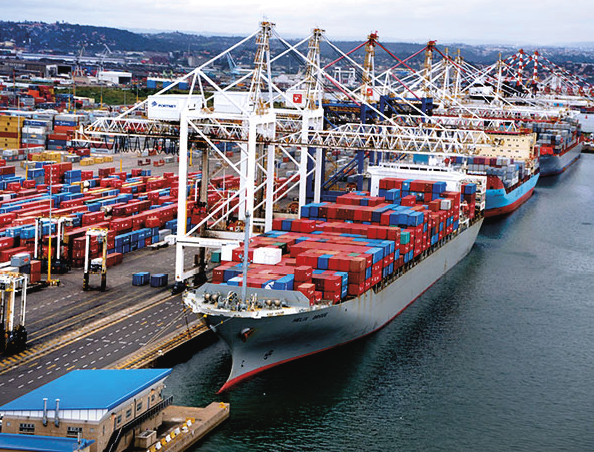
One of the most important decisions of 2025 regarding the economy of KwaZulu-Natal took place in the Durban High Court where a ruling was made against an attempt to block an agreement for a private operator to run Durban Container Terminal 2.
The R11-billion, 25-year deal between state utility Transnet and Phillipines-based International Container Terminal Services (ICTSI) was opposed by Maersk APM Terminals. ICTSI operates in 20 countries and employs more than 11 000 people. Transnet will hold 50% plus one share in the JV for 25 years, with an option to extend to 30 years. From the initial list of 17 potential partners, ICTSA was eventually chosen from a shortlist of six. Part of the plan is to increase the terminal’s handling capacity from the present 2.9-million TEUs (two-million 20-foot equivalent units) to 11-million TEUs by 2032.
With an earlier Transnet project to partly privatise some rail branch lines having stalled because the terms of the projected leases were too short, there was a danger that the idea of opening up sections of South Africa’s logistics infrastructure to the market would stall altogether.
That obstacle was also cleared in 2025, with 10 operators being chosen by Transnet Freight Rail from 25 applicants to run extra trains on important commodity routes. None is more important than the container corridor between Johannesburg and Durban. This route will have an additional four companies carrying containers on five routes. Which outcome will surely come as a relief to drivers on the N3 highway, South Africa’s busiest road.
A private logistics operator is also responding to the congestion on the N3. Central to the business plan of EIT Group’s Estcourt Intermodal Freight Village is the fact that the town is where the journey from Johannesburg to Durban becomes much steeper, with the higher inclines leading to higher fuel costs for trucks and the risks of accidents increasing. The plan proposes that loads get transferred to trains for the final 176km to the Container Terminal and Bayhead main rail terminal at the Durban port.
Supporting the plan is lower warehousing costs in Estcourt than in bigger centres. In November 2025, EIT Group announced that it was about to “expand into a multi-billion-rand operation that will set an important precedent for containing logistics costs and making local manufacturers more competitive”.
The Intermodal Freight Village, located on the former site of a Masonite board manufacturing facility, is beyond the proof-of-concept phase and now envisages expansion on both sides of the railway line. A second terminal will deal with minerals and “dirty” cargo while the existing (enlarged) terminal will handle clean cargo. EIT’s first test train ran in November 2023, and operations officially began in March 2024. Negotiations with Transnet Freight Rail delivered three slots to run trains on the main line to Durban each week with plans to increase this frequency.
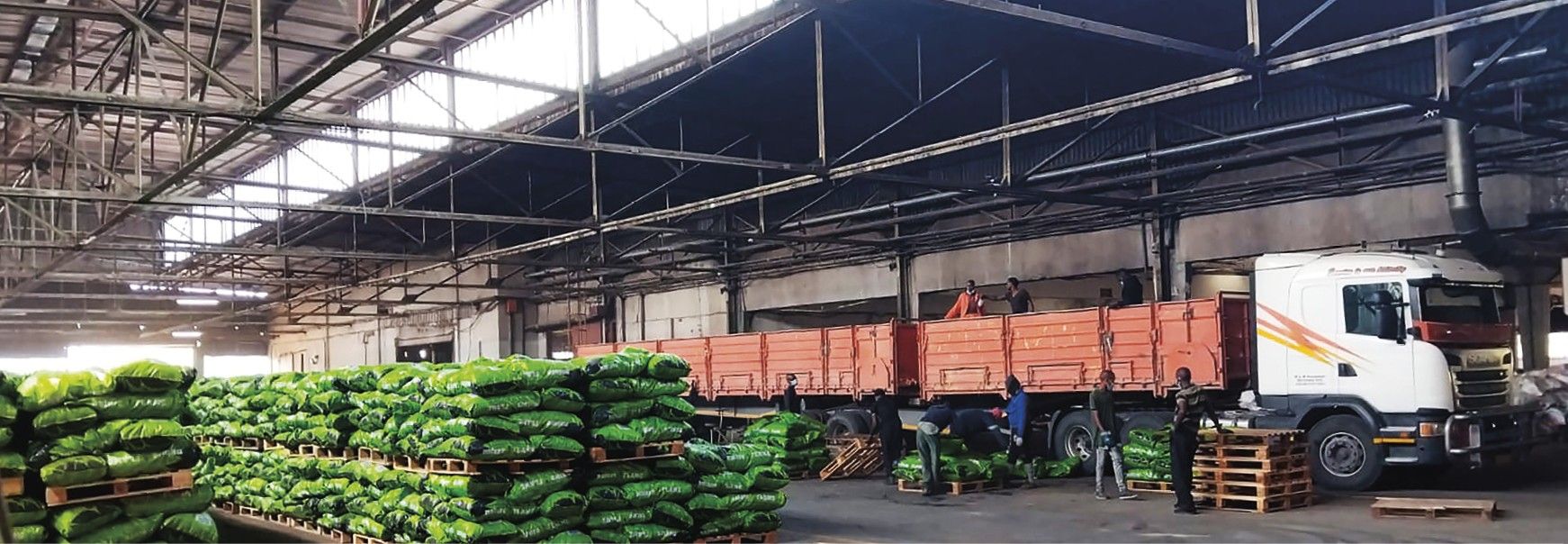
In January 2024 President Cyril Ramaphosa was on hand to oversee the first goods to leave South Africa from the Port of Durban under the African Continental Free Trade Area (AfCFTA), the agreement whereby most African countries will trade with one another with greater freedom. This new avenue for trade makes efficient logistics more important than ever. Unlike other continents where intra-continental trade has boosted economic growth, exports between African countries is at about 16%. Asia is 55%, North America 49% and the EU 63%.
Conducive environment
The KwaZulu-Natal Department of Economic Development, Tourism and Environmental Affairs (DEDTEA) has merged several of the entities which report to it. The changes are designed to improve efficiencies and boost economic growth. The new entities are:
- KwaZulu-Natal Economic Regulatory Authority: To regulate the gambling and liquor industries.
- KwaZulu-Natal Tourism and Film Authority: Marketing and promoting the tourism and audio-visual industries.
- Moses Kotane Research Institute: Economic research, promoting innovation, coordinating training.
- KwaZulu-Natal Growth Fund Agency (KZNGFA): This agency’s Act was approved for listing under the Public Finance Management Act, and a number of engagements were held with the public in the course of 2024/25. With a focus on black-owned businesses needing funding between R20-million and R100-million, support is provided in sectors such as manufacturing, mining, agro-processing, tourism, healthcare, transport and logistics, education and energy.
Speaking after presenting his budget in April 2025, the MEC for EDTEA, Rev Musa Zondi, noted that economic activity in the province was on the up and up. He said, “Industrial parks are being revitalised. Small businesses in townships and rural areas are accessing bulk buying schemes and finance. Our airports are being upgraded. Our ports are being modernised. And our energy agenda is in motion.”
He went on to list a number of economic indicators and investments to underscore his point:
- R85.2-billion worth of private-sector commitments at the 2024 KwaZulu-Natal Investment Conference
- Princess Mkabayi Mall in Vryheid and the Prince Mangosuthu Buthelezi Mall, Empangeni
- R10.8-billion SAPPI expansion in Umkomaas
- Colenso Power Project, clean-energy facility in uThukela District
- Expansion of Richards Bay Minerals
- NPC-Hauxin Cement modernisation on the South Coast
- A new industrial park at the former Karbochem site in Newcastle
- The cannabis-processing facility in Bergville
- The cable-car project in Okhahlamba
- Upgraded airports in Ulundi, Richards Bay and Mkhuze
The province’s existing infrastructure, good soils and fine weather provide a solid base for a varied economy. KwaZulu-Natal has significant capacity in heavy and light manufacturing, agro-processing and mineral beneficiation, all of which is supported by South Africa’s two busiest ports (Richards Bay and Durban), the country’s most active highway (the N3), a modern international airport and pipelines that carry liquids of all types to and from the economic powerhouse of the country around Johannesburg in the interior.
Mondi and Sappi, two global giants in forestry, paper and packaging, have a significant presence in KwaZulu-Natal.
Tourism is a key sector in the KwaZulu-Natal economy and provides livelihoods to many thousands of families in urban and rural areas. A number of flights have been resumed to King Shaka International Airport by the likes of Turkish Airlines and a new flight has been inaugurated by SA Airlink, connecting the province to Zimbabwe.
The provincial government is working on an investment pipeline, through the Special Economic Zones (SEZs), of R22-billion. The SEZs at Richards Bay and King Shaka International Airport (the Dube TradePort) are key components of the strategy and are now well-established nodes of investment.
In 2024, Dube TradePort’s Trade Zone 2 reported R1.4-billion earmarked for construction projects and the Ogihara SA manufacturing facility is nearly complete. Since inception Dube TradePort has attracted R4.6-billion in private-sector investments and created over 5 000 permanent jobs and 51 000 indirect jobs (SOPA).
At Richards Bay Industrial Development Zone Nyanza Light Metals were busy with site preparation at the start of 2025 and were expected to begin construction of the commercial plant later in the year. In October 2025, IOL reported that the African Development Bank (AfDB) had approved $75-million for Nyanza’s large-scale titanium processing plant.
Transnet National Ports Authority (TNPA) and the Zululand Energy Terminals Consortium are yet to make a final decision to invest in an LNG Terminal in Richards Bay but they have been chosen as the preferred operators.
Automotive excellence
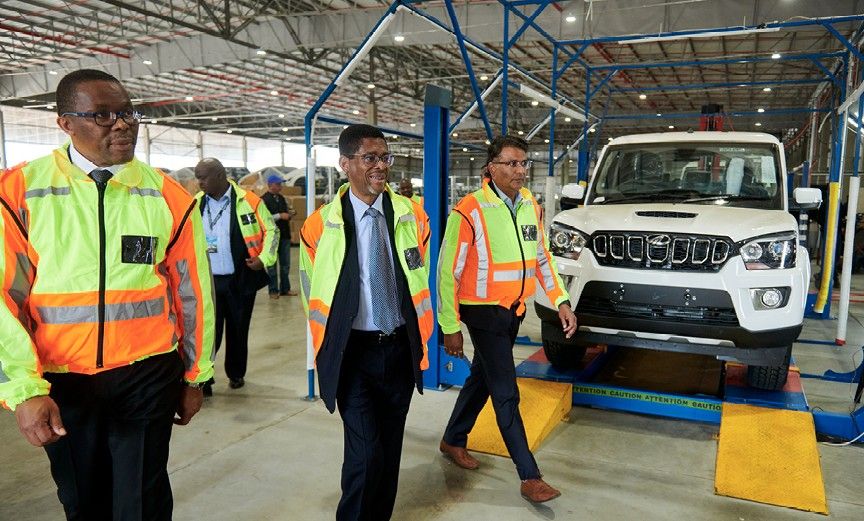
Mahindra, which has operated a semi-knocked-down assembly plant at a site in the Dube TradePort since 2018, opened a new plant nearby in 2025. The modern plant will assemble Pik Up single-cab and double-cab models and will scale up as demand increases. Mahindra is also investigating whether or not to build a full-scale manufacturing plant and is doing a feasibility study with the Industrial Development Corporation.
KwaZulu-Natal’s two biggest original equipment manufacturers (OEMs), Toyota South
Africa and Bell Equipment, are among the province’s biggest exporters. From its factory south of Durban Toyota exported 71 014 Hilux vehicles in 2023, to go with the 37 382 units of the same model that it sold locally.
About 40% of Bell Equipment’s South African turnover is accounted for by exports, which are sent to more than 80 countries. The company has a large plant in Richards Bay as well as a facility in Germany. Bell was the first winner, in 2019, of the Exporter of the Year Awards for capital equipment manufacturers offered by the South African Capital Equipment Export Council.
In 2023, Bell launched a new division, Bell Heavy Industries. Project engineering and contract manufacturing will be the focus of the division, which builds on seven decades of experience in complex engineering, heavy fabrication and machining for its own range of material handling equipment.