

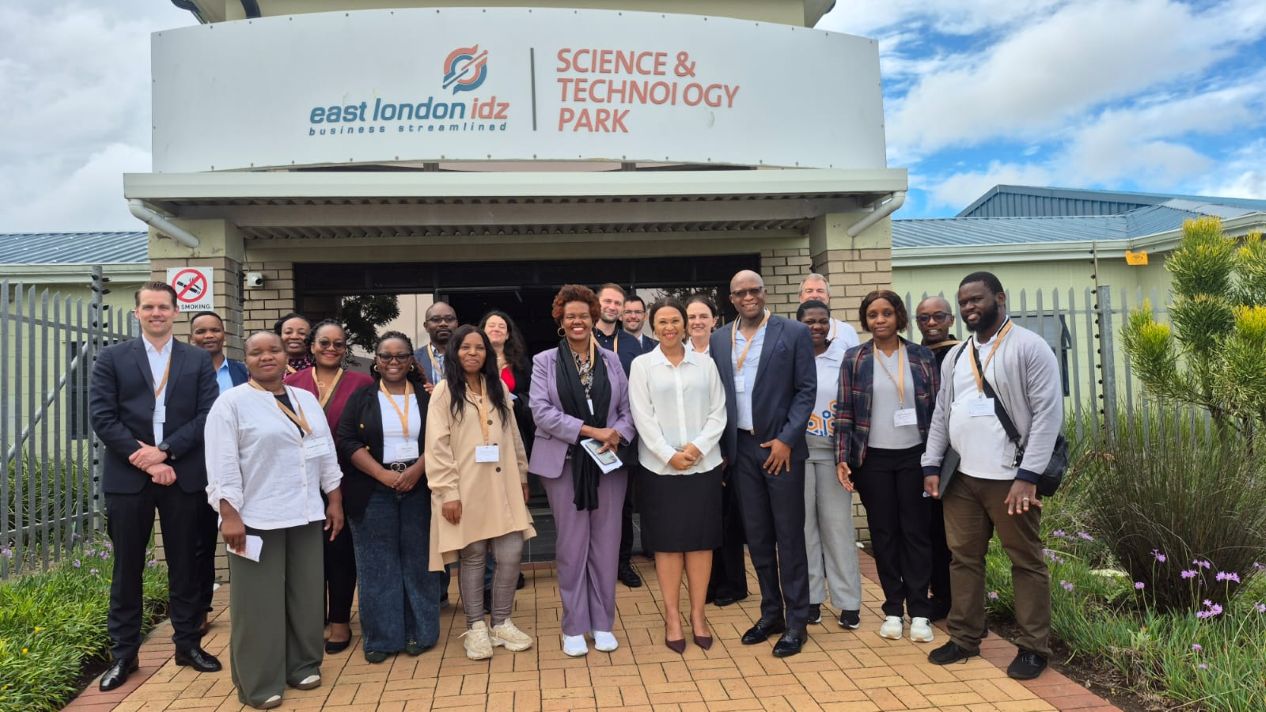
The NatuReS II Regional Learning Exchange 2026 concluded yesterday at the East London Industrial Development Zone (ELIDZ), marking the end of three days of intensive dialogue, hands‑on learning and regional collaboration focused on strengthening water stewardship in Africa’s industrial regions.
Hosted from 24–26 February 2026 by the ELIDZ in partnership with the GIZ Natural Resources Stewardship Programme II (NatuReS II), the gathering brought together delegates from South Africa, Ethiopia, Zambia and Tanzania, uniting government leaders, private sector representatives, water managers, academia, civil society and development partners under one shared mission.
From the outset, the event centered on the theme “From Source to Industry: Stewardship Multi‑Stakeholder Partnerships for Socio‑Ecological Transformation and Water‑Smart Industrial Futures.” This theme shaped the flow of discussions, grounding every conversation in the reality of a changing climate, increasing water risks and the urgent need for collective, systems‑level approaches to sustainable industrial development.
“This theme is not aspirational for us—it reflects who we are today and the future we are deliberately building. It speaks to our long‑standing commitment to environmentally responsible industrialisation and our intentional transition toward a water‑smart, eco‑industrial model grounded in science, governance and partnership,” said Ayanda Ramncwana, Chief Operations Officer of the ELIDZ.
She noted that operating in a water‑stressed province demands responsibility, foresight and discipline, which is why the ELIDZ embeds environmental governance, monitoring systems, green‑building principles and risk‑based management into its operations. “At the centre of this transition is water, because our priority sectors are water‑dependent, and secure, well‑governed water systems are now fundamental to competitiveness, investor confidence and long‑term resilience.”
A major thread running through the exchange was the recognition that industries can no longer depend on a single, traditional water source.
Speakers and technical experts repeatedly highlighted the need for decreasing water risk, especially as climate variability intensifies. A task which cannot be tackled successfully by one sector alone, rather requires collaborative action including a wide range of stakeholders – including public and private sector and civil society.
Delegates explored a range of alternative water sourcing methods, examining how each contributes to building long‑term operational stability and resilience.
Rainwater harvesting featured strongly in the discussions, not as an idea but as a practical, underused solution with immense potential. Several speakers emphasised how harvesting rainwater can reduce pressure on municipal systems, offer an emergency buffer during shortages, and help industries lower their operational and environmental footprint.
The discussions around rainwater collection illustrated how even simple interventions can significantly strengthen resilience when built into a broader diversified approach.
The ELIDZ’s own Sea Water Pump Station emerged as a compelling real-world case study of alternative source in action. Delegates had the opportunity to explore how seawater abstraction, supported by appropriate treatment technologies, can supplement freshwater supplies and serve process‑specific industrial needs. The visit demonstrated how such systems could enhance resilience in coastal industrial zones that face growing water stress, positioning seawater as a viable and increasingly necessary component of future water portfolios.
The ELIDZ’s own Sea Water Pump Station emerged as a compelling real-world case study of alternative source in action.
Experts also unpacked the role of groundwater supplementation and Managed Aquifer Recharge (MAR) as part of a holistic water strategy. These insights underscored the importance of responsible governance, careful monitoring and strong catchment‑level collaboration to ensure groundwater use is both safe and sustainable. Complementing this, several case studies illustrated how treated wastewater can be effectively reused in industrial processes, reducing dependency on potable water and advancing the shift toward circular resource management.
Across all sessions, one message was clear: integrated multi‑source water planning is no longer optional. Delegates echoed the need for industrial zones to adopt diversified portfolios combining municipal supply, rainwater harvesting, groundwater use, seawater sourcing and wastewater reuse — a strategic safeguard in a climate‑stressed future.
Reflecting on these insights, Sarah Beerhalter, Head of Programme for GIZ–NatuReS, noted that the discussions and technical visits demonstrated the value of integrated, multi‑source planning and evidence‑based decision‑making. She added that broader water stewardship supported by strong partnerships and scientific insight is essential for building resilient, water‑smart industrial regions capable of withstanding climate pressures and supporting sustainable growth.
The knowledge-rich panel discussions served as the backbone of the exchange, offering regional insights into policy, governance and economic imperatives. Conversations on water resilience and industrial competitiveness demonstrated how water insecurity can disrupt supply chains, undermine export reliability and weaken investor confidence. Experts highlighted the importance of building redundancy through multiple water sources and by applying water efficiency measures, emphasising that coordinated catchment‑level action is now essential for safeguarding the continent’s industrial output.
Conversations on water resilience and industrial competitiveness demonstrated how water insecurity can disrupt supply chains, undermine export reliability and weaken investor confidence.
Industry representatives participating in the business case dialogue shared how stewardship partnerships are helping them de‑risk operations, comply with water efficiency and reuse regulations, and strengthen ESG performance—factors that increasingly influence global investor decisions.
Meanwhile, delegates from Ethiopia, Zambia and Tanzania provided reflective insights into the governance mechanisms needed for effective multi-stakeholder collaboration, underscoring the importance of trust, transparency and locally appropriate partnership models.
From a national perspective, Thami Klaasen, Director for Regional Industrial Development at the dtic, said the exchange directly supports South Africa’s work on strengthening water stewardship in industrial parks and SEZs. He noted that the dtic, together with GIZ, is developing standard operating procedures grounded in accurate data and research, supported through pilots at the ELIDZ, Richards Bay SEZ and parks like Rosslyn. Klaasen stressed that multi‑stakeholder engagement is central to identifying risks and co‑creating solutions and emphasised that decisions on alternative water sources must be informed by scientific evidence rather than assumptions.
The technical tours added an invaluable practical dimension to the exchange. Delegates visited the Science and Technology Park (STP) CAS Laboratory, the ELIDZ Seawater Pump Station and the Buffalo City Metropolitan Municipality (BCMM) Wastewater Treatment Plant. These three sites together reflect long-term commitment to a Net Zero Water future.
These visits showed how industrial zones and municipalities can integrate multiple water sources, apply scientific monitoring and build water systems that extend beyond traditional boundaries.
The tours illustrated how the Zone is transitioning from conventional water management to broader water stewardship—where risks are understood and addressed both within the zone and across the surrounding catchment. Such stewardship partnerships not only support economic development but also focus strongly on environmental health and socially fair sharing of resources.
On the final day, discussions centered on the Natural Resources Risk and Action Framework (NRAF), a methodology that helps stakeholders and organizations to operationalize stewardship partnerships and design implementable, risk reducing strategies tailored to realities in African countries. Delegates explored how the framework enhances risk assessment, aligns interests across sectors, and supports multi-stakeholder decision‑making—a critical component in regions facing layered water challenges.
As the programme drew to a close, delegates reaffirmed their commitment to strengthening collaborative water governance and scaling multiple water‑source initiatives across Africa.
The ELIDZ and GIZ NatuReS renewed their pledge to continue supporting regional partners in advancing water‑smart and climate‑resilient natural resource management for a broad range of stakeholders – including industry.
The gathering ended with a shared recognition that Africa’s industrial future depends on stewardship, innovation and a sustained commitment to resource‑use efficiency, circular models and redesigned water systems for long‑term resilience — indicating that Stewardship Multi‑Stakeholder Partnerships remain a powerful model for collective action on water security across Africa and beyond.