
Programme Director: Ms Zinathi Gquma of CNBC Africa
Distinguished panelists
Leaders from mining, manufacturing, finance, development finance institutions and organised business
Ladies and gentlemen,
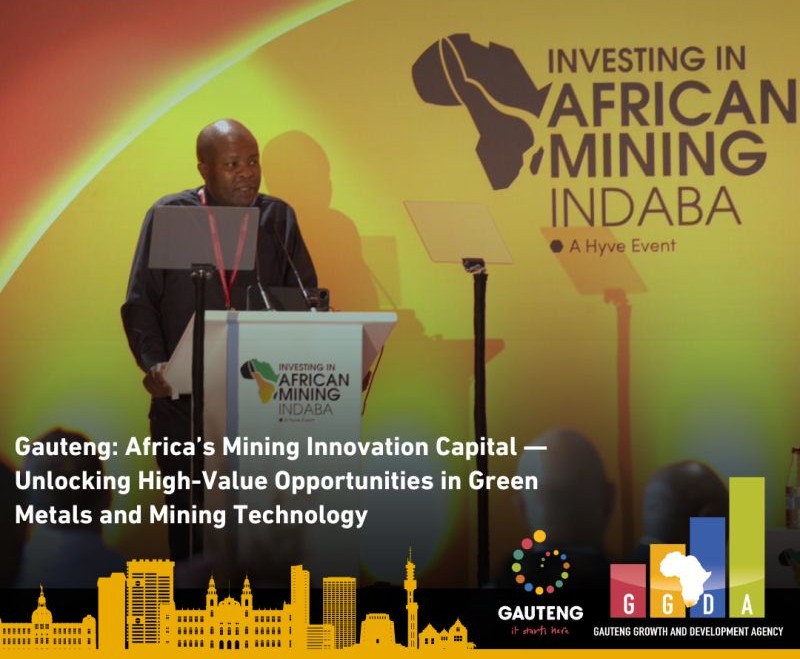
Mining Indaba remains one of the most important gatherings on the African and global investment calendar because it brings together the entire mining ecosystem. This includes mining companies, investors, technology providers, financiers, policymakers and development institutions all under one roof.
For Gauteng; our presence here reflects the province’s role in South Africa’s mining and industry value chain.
Gauteng was built as the Place of Gold. Today, its mining story is no longer only about extraction. It is about where value is created, where capital is anchored, where technology is applied, and where the future of mineral-based industrialisation is taking shape.
Let me ground this conversation in evidence. While primary mining contributes only around 1.7 to 1.8 per cent of Gauteng’s GDP, the province continues to play a central role in South Africa’s mining economy.
-
- Gauteng hosts most of the continent’s mining finance, capital equipment manufacturers, corporate headquarters, and key support services like engineering, legal, ICT, and technical expertise;
- The province provides 16 to 17 per cent of South Africa’s mining jobs, which is around 79,000 people; and
- Mining also supports between 50 and 55 per cent of Gauteng’s total exports, even though most of the minerals themselves are mined in other provinces.
This shows that Gauteng’s mining role has changed. It is no longer just about digging minerals from the ground. Today, it is about creating value, supporting trade, building skills, developing technology, and driving industrial activity across the country and the continent.
In the past five years, Gauteng has attracted about R12.8-billion in mining-related investment, creating over 1,500 new jobs in areas like beneficiation, metallurgy, equipment manufacturing, automation, and advanced services.
This progress comes from deliberate investment, planning, and hard work. It also sets the direction for where we want mining in Gauteng to grow in the future.
In the Gauteng Economic Development Plan, the mining sector is highlighted through the Mining Sector Master Plan as a key driver of growth. Mining supports downstream activities such as mineral beneficiation, equipment manufacturing, industrial services, logistics, exports, skills development, and capital expansion across the province.
This approach ensures that mining policy advances industrialisation, localisation, green metals development, and the attraction of long-term investment.
The global economy is entering a phase where minerals are in high demand. The World Economic Forum makes this clear in its 2024 White Paper Translating Critical Raw Material Trade into Development Benefits, where it states “Demand for critical raw materials is rising because they are needed for clean-energy technologies, and current projections suggest that demand may soon exceed supply.”
Under net-zero scenarios, the need for minerals used in electric vehicles, batteries, renewable energy systems and power grids is expected to grow two-and-a-half to three-and-a-half times by 2030. Meeting this demand will require about US$400 billion in global investment in mining, refining and processing by that year.
Gauteng is well positioned to play a central role in this. South Africa has significant reserves of platinum group metals, manganese, chrome, vanadium and gold. Between 2020 and 2024, the country exported R3.9-trillion in mineral commodities, with Gauteng accounting for most of the value in PGMs, manganese, chrome and coal exports.
The World Economic Forum also issued a warning, which shows why policy, investment and delivery must work together. It cautions that sustainable development does not happen automatically from mining alone. It requires investment, planning, and effective policy.
In other words, having minerals is not enough to create growth. Value is realised where processing, manufacturing, skills, technology, finance, and logistics come together. This is why Gauteng has focused on building both the upstream and downstream parts of the mining value chain as a key driver of economic growth.
South Africa’s Critical Minerals and Metals Strategy, published in 2025, makes the same point. It notes that local processing and beneficiation of critical minerals could create up to 2.3-million jobs and boost Africa’s GDP by 12 per cent, provided infrastructure, energy and logistics challenges are addressed.
Gauteng hosts the downstream and supporting layers of mining and green metals industries, including metallurgy, fabrication, mining equipment, automation, engineering, project finance, logistics, and professional services. Across Southern Africa, this positions Gauteng as a regional industrial hub, supporting cross-border mineral value chains under SADC and AfCFTA, rather than competing with extraction-focused provinces or neighbouring countries.
This approach directly aligns with global and regional research, emphasising the following:
-
- Regional integration;
- Value-chain coordination; and
- Investment facilitation.
These are critical mechanisms for translating mineral demand into sustainable development benefits.
Today’s Industry Intel Session focuses on targeted, action-orientated investment discussions in areas such as the following:
-
- Green metals and critical minerals value chains;
- Mining technology, automation, and capital equipment manufacturing;
- Beneficiation and localization; and
- How special economic zones, infrastructure, skills pipelines, and development finance work together to turn mineral demand into bankable industrial projects.
As the programme shows, the session moves from strategy to implementation, linking Mining Indaba engagements directly to Gauteng’s investment pipeline and the Gauteng Investment Conference 2026.
Let me be clear to investors, financiers and industry leaders in the room. Gauteng is not competing on low wages or regulatory shortcuts. We are competing on:
- Institutional depth and policy certainty;
- Financial sophistication and technical capability;
- Industrial platforms enabled through SEZs; and
- Market access at scale, both regionally and globally.
The South African Critical Minerals Strategy of 2025 sends a message that aligns closely with Gauteng’s approach. It states: “The future of our country is closely tied to how we develop and manage our mineral resources. By strengthening our industrial base and increasing value addition, we can create jobs, drive innovation, and advance economic growth.”
That is exactly what this session is about: a practical, focused engagement. The future of mining in Africa will not be shaped by extraction alone but by how we use mining to build integrated, high-value, and resilient industrial economies across the continent.
Thank you.
References
- South Africa Critical Minerals Strategy (2025)
- World Economic Forum (2024) – Translating Critical Raw Material Trade into Development Benefits
- GDED Gauteng Economic Development Plan
- GGDA Macro Business Intelligence (2026) – 8 Reasons Why the Mining Sector Matters to Gauteng
- World Economic Forum (2025) SADC Critical Minerals & Industrialisation Note